Monday, April 27, 2009
Vegan Walks into a Bar
But guests for lunch: one vegan, at least two vegetarians, and a person with health reasons for not eating spicy foods.
We ended up with an amazing soup based on a wild mushroom stock from The Greens Cookbook. Incredible. Worth buying the book just for this stock, which starts with dried porcini mushrooms and ends up having several layers of flavor.
And a pasta salad, and a green salad, and bread, and a fruit salad and chocolate chip cookies for desert, during which we bandied about Sanskrit terms and wrestled with the five ways of thinking (Sutra I.6 - correct perception, incorrect perception, imagination, deep sleep, and memories - or pramana, viparyaya, vikalpa, nidra, smritti) and examples of how each can be beneficial or not (aklista and klista).
Sunday, April 26, 2009
Another International Seafarer's Ministry Cap
Thursday, April 23, 2009
Balance
One of my favorite balancing poses to teach is Vrksasana (pronounced vrik-shah-sahnah) or Tree Pose. (But look toward the horizon, please, not up.) It is accessible to most students, especially if they let themselves start out by standing with one side against a wall, so that when balance becomes shaky, they can connect with some support.
The posture is done by first feeling one foot really connected to the floor. I have my students start by raising the toes and pressing down into the heel, then lifting the heel and pressing the ball of the foot against the floor, then rolling to the inside edge of the sole, then the outside edge. Then, I instruct them to feel all four corners of the foot simultaneously - as though the foot is suction cupped to the ground. Next, they bring one foot against the lower calf or the upper thigh. Hands come to the heart, and now the really interesting part of the pose begins. Because in order to reach up, you need to reach down into the feet. And in order to balance, you need to allow the ankle to wobble -- and then react to that wobbling by reinstating balance.
This is what I love about the pose: it allows us to experience the fact that balance comes not by finding a state of equanimity and sticking there forever - but by reacting, moment by moment, breath by breath, to change. And by illustrating that progress - represented in Vrksasana by the ability to lift the crown of the head, straighten the spine, and bring the arms over the head with the palms against each other - not by reaching forward, but by grounding, reaching in the opposite direction of down, into the feet, versus up, into the air. It tells us that growth is a process like that of a garden growing: the seed has to reach down, set roots, in order to reach up into the air and develop. Hmmm. All this in one little yoga pose.
I've been reading an amazing book called Balance by Scott McCredie, that says far more about the incredible systems within us that keep us balanced throughout our lives. We have three different processes - vestibular balance, situated in the ear canals, which tells us how our head is oriented in relation to the world around us; vision; and proprioception, or cells within muscles and joints that tell us where one part of the body is in relation to another. McCredie explains these systems in layman's terms and gives some intriguing examples, including why humans love rocking chairs; why JFK Jr.'s plane went down while he was flying at night; and how balance helped the Homo sapiens survive while the clumsy Neanderthals became extinct. And he argues, very convincingly, that balance is a sixth sense which we must practice as often as possible to avoid the falls that incapacitate so many elderly people.
McCredie says that we are like large triangles balanced on one little point - our feet. Imagine a large football player or a Sumo wrestler, and consider how surprising it is that these athletes can dance about with all that mass poised above a small platform against the earth. At the end of the book, he gives several exercises to do to practice balance.
Or, you could take a yoga class and see how it changes your sense of balance. Let the ankle wobble. That's what it is designed to do; it is made up of several small bones that allow us to shift and reorient in relation to gravity, change, our breath. And then notice that still feeling within, at the center of the pose, where you find a moment of no wobble, no activity, but balance, even for just a second of time.
Tuesday, April 21, 2009
Work in Progress
This seems to be working better. I'm wondering if the microfiber in the yarn was not suited to the design of Vivian, which is beautiful, but has tons of seed stitch and cables and twists. Maybe the weight of the knitting was pulling on the yarn enough to cause it to stretch when worn - an effect that seems less likely with the heavier woolen yarns that most knitters on Ravelry are using. I reswatched with some Cascade Eco and like the effect, so someday I'll go back to the pattern.
And here's work in progress on H's bedroom. Ruskin Room Green on the walls and Dard Huner Green on the baseboard. Both from Sherwin-Williams' collection of Arts and Crafts colors. How can you not love a paint company that names its products after an English aesthete and an artist known for his handmade paper?
Tuesday, April 14, 2009
Van Gogh's Bedroom
This is one of my favorite rooms. And an interesting journal entry by Van Gogh on the room, here. Or maybe Monet's house, particularly the yellow dining room and the blue entry hall with green door.
Monday, April 13, 2009
New Toy
Finally broke down and bought a new sewing machine. Lots of bells and whistles, even on the most basic machine in the shop.My last machine - a small Singer industrial model from my father's business, rebuilt after a warehouse fire - gave up the ghost several years ago, and since I rarely used it for anything other than finishing off my weaving or doing a small repair, I never replaced it.
This new toy threads its own needle, threads its own bobbin, switches from foot to foot with a small lever, and makes 40 or so different stitches just by me changing the channel-type readout on the front of the machine. Oh, and it figures out how big to make the buttonhole when you insert the button you're using into a plastic gizmo that attaches onto the foot. That, after you choose among four or five different buttonhole styles. And, my most favorite part, all the tiny parts store in a little cubby on the front of the machine.
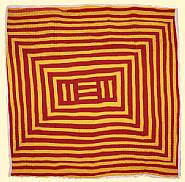
Not that I expect to need most of this. Here's what I would love to make: a quilt as amazing as the iconic Gee's Bend quilt. This one and the one at the top are both from the collection.
Incredible. If you have a suggestion for a pattern, or have a quilting blog to recommend, please help to bring me into the 21st century, so that I can make something old-fashioned.
Saturday, April 11, 2009
Painting Project
The room has northern exposure. And it looks directly out at the neighbor's grey siding and empty windows.
My initial plan was to paint the walls something warm. I've swatched two different shades of apricot-ish orange, but I'm not loving either. Meditation brought a thought that maybe I should stop fighting the nature of the room, which is to feel cool and dark, and instead try supporting those qualities with a rich, dark grey or brown. Or shale, the trademark color of my old employer: a brown with warm undertones of rose and pink. Or something Oriental: green walls in Faded Silk from Ralph Lauren paints, dark green enamel trim on the windows, and an Oriental-style carpet?
Thursday, April 09, 2009
This Year in the White House
Tuesday, April 07, 2009
Sailor's Rib Socks
These are the Sailor's Rib Socks from More Sensational Knitted Socks. Knit in Colinette Jitterbug in a color called Velvet Leaf. (My father asked if I was knitting for the Israeli Army, which I well could have been, but was not.) The yarn shop in Florida had six skeins of this color, three neon yellow, and one neon purple. I was in a green mood, happy to see that trees actually still have leaves and grass grows beyond the weather-zone of a Chicago winter.
And these rate as my happiest knit of socks so far. I worked them on a size 1 32" Addi Turbo circular, which, once the cord softened up a bit, were easy to navigate with the Magic Loop method. And though I think that the next pair will have the pattern continue down the instep )for prettiness' sake), there is virtue to stopping the pattern at the ankle and working the rest of the sock in stockinette. (Moment of sidebar: gee, is that where the stitch got its name - from ye old stockinette socks?) The virtue is speed and ease of knitting. All that you need to keep track of is how much further to knit until it's time to start your decreases for the toe.
And a note to frugal knitters. I knit my sock on 48 stitches, followed the schematics for a size 7 1/2 woman's sock, and had enough yarn left that I could have eked out another inch or two for each leg portion of the sock. (But don't buy Colinette in a resort area in Florida. The shop charged a heart $6 more than my local yarn shop, and this is not inexpensive yarn, to start with.)
Monday, April 06, 2009
The Runcible Bin
Some beauty. Some craft. Short, sweet, present, smart.
It's blogs like this that make the most sense to me, and what I aspire my blog to be.
Sunday, April 05, 2009
Finally, a Hat for Linda
Friday, April 03, 2009
It's Not All About Me
You could be having a conversation with her and be nattering on about something or other, and she would tap you on the arm, stop you, point at herself, and say "excuse me...did you forget that it's All About Me?" This was such a stock saying that one of my coworkers found a banner for her to display on the office door, declaring "It's All About Me."
Now, she could get away with this because she was an amazing boss. She was compassionate, tough, smart, charming, and had the best stock of strange Southern sayings that I've ever heard. (Apparently, they learn these as young whippersnappers, growing up in the state of Texas.) I worked for her seven or eight years ago, but whenever I run into someone who is unable to delegate because she knows that she can do it better, faster, easier, I still tell the story of the time that my boss caught me on a two-story ladder in the stockroom, working on sale merchandise. She made me come all the way down, and then asked me: "Do you want to be the hardest working person in this store forever? Or do you want to teach other people to help you?"
So, consider me as having an affection for All About Me. But this morning I thought to myself: it's not about me. I was driving to teach my Friday morning class at the new studio, where my classes average between four students to none. And though I've been aware that it's not entirely personal (the weather, the economy, kids being out of school, the time of the class, the teacher that one connects with - there are a million reasons why people go to one class versus another), it feels, at the same time, like a test of personality.
But this morning, it came into my head: it's not about me. I'm just a stand-in for the teachings. My job is to show up, take the students through a practice that has some sense and sequencing and intention to it, teach to the best of my abilities, maybe slip a little lesson in about the better parts of our natures and how yoga can help us move toward that, and have some fun. That's it. Whatever happens after that, I can't control.
This does not mean that tomorrow and ever after, I will always be feeling It's Not All About Me. The Yoga Sutra-s say that our patterns - our samskara - never go away. They just become latent, riding beneath the surface, pushed down and aside by more beneficial patterns that rest on a bit more clarity and a little less suffering. Maybe I need to find a banner for my door that says: It's Not All About Me.
Wednesday, April 01, 2009
Structuring a Vast Wasteland of Time
Rajas, or movement, is one of the three gunas -- qualities or elements or personality features - that make up each person. The others are sattva - or calm, peacefulness - and tamas - heaviness, inertia. As in many Eastern systems, there is no hierarchy here; each of us is a mixture of these three elements, and the ratio of one to another changes, somewhat, based on the activity or life we are engaged in. For instance, we all need some tamas so that we sleep and rest, but not so much that we sit on the couch all day, eating chips and watching Netflix. Rajas is valuable for a bike messenger who needs to keep moving to accomplish her job, but in too great a dose, could reinforce hyperactivity or lack of focus. It is wonderful to be sattvic - judicious, measured, wise - but in the middle of an emergency, do you want to stop and ponder the situation or call 911?
For me, rajas can be agitating. I like to have big blocks of time, spent on one thing; not too much moving from place to place, whether that's for errands or when traveling; and a reasonable dose of quiet each day. Here's where the structuring part comes in: I can't seem to make myself sit still and come up with a plan for some stasis amidst all this moving about, teaching different classes, working on developing a business, and all the little to-do's that crop up like weeds in a spring garden.
One thing that has helped is to vastly simplify my knitting. And to do a few rows most mornings while I drink my first cup of coffee. I've retired Vivian until I can figure out whether to drop down to a smaller needle (size 7 worked great on the sleeves but is creating too big a body), go down a size and start over with the body, or decide that the yarn (Debbie Bliss Cashmerino instead of the heavier wool called for) is too stretchy and decide to make something different from it.