Tuesday, September 29, 2009
Socks
Thursday, September 24, 2009
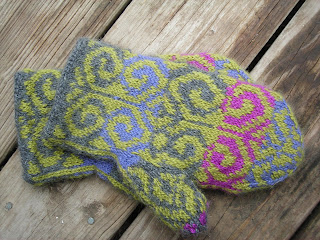
Fiddlehead Mittens
- start hand decreases on Row 55 of main chart
- mitten shell totals 65 rows instead of 72
- not a size modification - but I liked the look of working the thumb in CC3 (contrast color 3) and the main color, and ending with a little bit of contrast in another color
- I repeated the last row of the gusset pattern before moving the stitches to a piece of waste yarn (apparently my thumbs are long in proportion to my hands - I'm observing them now, and they almost reach the first knuckle of the index finger...is that typical?)
- start decreases for thumb on row 7 of Chart C
- decrease next 3 rows
- work 1 row even with MC and finish off
- for the lining: I worked 26 rows to the start of the thumb gusset; then 3 rows after completing the gusset before moving stitches to waste yarn; then 33 rows straight on the main part before beginning the decreases for the top of the liner
The result is a really beautiful piece of knitting. At a semi-affordable yarn investment. (Well, I've been looking at catalogs that are calling for 12 and 13 skeins of yarn at $10 and more a skein.) And very reassuring to knit: clear directions, a Ravelry support group available with good threads of discussion, logical, great charts. And the color? I went with one color for the details and four other colors for background, but you can flip it around and do five colors for the details and one color for the background, or use up scraps around the house, or dye your own. If I was stuck for The Long Winter, I'd want this pattern and some yarn.
Monday, September 21, 2009
Napkins. Finally.
Friday, September 18, 2009
Honey and Apples
And a blessing for parents to say for their children: Be strong for the truth, charitable in your words, just and loving in your deeds.
Thursday, September 17, 2009
Summer-and-Winter Cloth
The first part of the warp used to make napkins. I'm glad that I only wove up a small section of the warp in this pattern. The cloth is lovely to look at - with the characteristic reversals of color and the even geometry of Summer-and-Winter patterning. But it is a bit heavy for a napkin - closer to the weight of a table runner. (This seems to be a trend lately for me.)
Next up is Trial #2 in devising a way to weave felted cloth for a yoga bag like this one from Last-Minute Knitted Gifts. And trying to devise a way to keep supply costs low and, at the same time, figure out the trick to dyeing yarn so that it has the beautifully gentle shifts of color of Malabrigo. If you know any tricks for kettle-dyeing or for weaving cloth that has the spongy feeling and thickness of knitted felt, please pass them along by leaving a comment or emailing me on Ravelry (my username is jbwb)!
Monday, September 14, 2009
Woven Swatches for Felting
Saturday, September 12, 2009
Felted Potholders
The weight is good for potholders: flexible enough to wrap around hand and pot handle, thick enough to guard against the heat of pots and pans.
Thursday, September 10, 2009
Border Songs
His art is inspired by Andy Goldsworthy; scenes of the character, six-foot-eight-inches tall Brandon Vanderkool building capes of leaves stitched together with thorns or swinging a club over water to create rainbows (look here for an amazing photo of Goldsworthy making rainbows) are luminescent. And he has the tenor of some of the great American characters - Tom Sawyer, a little, Atticus Finch, a bit, Steinbeck, a dose.
Brandon is accompanied in this novel by a group of equally eccentric, equally realistic characters, including his father, Norm, who is struggling to keep the dairy farm going while he builds a sea-going sailboat in the back barn (neighbors gathered to watch, only to see if the boat wouldn't fit into the barn); Wayne Rousseau, the ex-professor across the ditch that marks the border between Canada and the U.S., retired, declining from MS, who is recreating the experiments of Edison and Ben Franklin (a great scene when Wayne takes his kite out during a thunderstorm to discover electricity) and the painting of Van Gogh; and Sophie Winslow, the mysterious massage therapist who is filming and interviewing everyone and who everyone wants to speak with, their rare chance for a confession because everyone is doing something just this shade of the black-and-white of the law.
Much remains mysterious enough throughout the book, making this novel and mystery and rumination about art and immigration and borders and a lot about marijuana - how it's grown, marketed, smoked. Overall, the novel has a sense of wonder. Brandon is very attuned to the life of nature around him and especially to birds. As he goes throughout his workday on the Border Patrol, he keeps a mental list of the birds he observes: "The agency's largest boots were a half size too small and gave him the floating sensation of being detached from earth. He heard the rat-a-tat of a downy woodpecker, twenty-nine, and the nervous chip of a dark-eyed junco, thirty" (6)
What I liked best about Border Songs, beyond the characters, was the ending. And individual sentences that are just right, like this one: "The looks you get or don't get let you know exactly where you're at, where you're headed and where you can never go again" (226).
Monday, September 07, 2009
Parinama
A little bit of background: in yogic philosophy of the school that I follow, there is purusa and prakrti. Purusa (pronounced pah-roo-sha) is that elemental piece of us that does not change. Some might think of it as the soul, others as an internal light. I explain it to my students in non-sectarian terms as that feeling that you have when you are comfortable in your own skin, at ease, happy, sensing that there is completeness and peacefulness to your experience at that moment. Prakrti (prah-kri-tee) is everything else: our bodies, our minds, our houses, our cars, our relationships, our knitting, our work, our ideas, our emotions. Everything but purusua, that perfect something that is unchanging.
Beyond that, I've been thinking this summer about how to take the training that I've done in yoga therapy and develop my therapeutic practice, working one-on-one with students, which I love. This conscious consideration is a big change for me. I tend to be the one in the family who rides on the "it will all work out" mode of behavior. More importantly, it is a big, big change from my response to the end of graduate school in English, when the downturn in the academic market led me away from teaching to other pursuits.
This time I am determined to put my studies to practical use. So I am inventing a website, writing and designing a brochure, learning how to talk about what yoga therapy is and what it has to offer, visiting and sending out cover letters and cold-calling and networking. Lots of changes. Lots of movement. Little stasis. Rare moments of learning curve.
And the illustrations for this ramble about change? Felting, of course. You knit something large and unwieldy but beautiful. You throw it into a vat of hot water and lots of movement. You wait. You check for progress. You wait some more. You check again. Even when you think that the felting process is done, you can't be sure, and there's no guarantee that this sodden, floppy piece of wool will ever back into something beautiful. And then, you try to accept the result. Whatever it is, is beautiful. Some would say that whatever it is, is what it was meant to be. Perhaps. What I do know is that two or three years ago, I wouldn't have trusted the messy ends on the back to disappear in the process of felting.
Sunday, September 06, 2009
A Face to Love
Saturday, September 05, 2009
Wednesday, September 02, 2009
Time
Being someone who prefers loooong stretches of time spent doing one thing (generally quiet, involving reading, knitting, or watching Project Runway), I am feeling a bit nutty with all of these tiny amounts of time in between teaching, returning phone calls, driving to introduce myself to other complementary medical practitioners in the western suburbs, driving to an appointment early enough to not run late but not so dang early that I have more than 20 minutes to kill.
The poster child for my state of mind is my loom. (I know, back then it was the loom that signified focus and the knitting that reminded me of how agitated I could be feeling. Parinama...change...I have no other defense.) Constant motion of throwing the shuttle back and forth, pressing down on peddles to raise and lower harnesses and threads, frequently advancing the warp and then tightening it up again and then advancing it and then tightening it. And every time that I sit down for a nice, long bout of weaving, I am close to running out of filled bobbins of weft thread and weave along, anticipating at any moment that I'll have to put the whole venture on hold while I use my hand-winder to fill some more bobbins.
Constant motion with no conclusion in sight. Thank goodness for chamomile tea and the occasional gorgeous fall weather, like yesterday, when I just sat out in the backyard and read A Letter of Mary for three hours. There is nothing like a smart, female narrator in a strongly-written mystery, with Sherlock Holmes as sidekick-husband to the main character, Mary Russell.
Tuesday, September 01, 2009
A Little More Horse Show
That is not a pond. It is the water feature that the horses gallop into, before jumping up and over a fence to exit. These are true athletes, and the riders aren't bad either.